
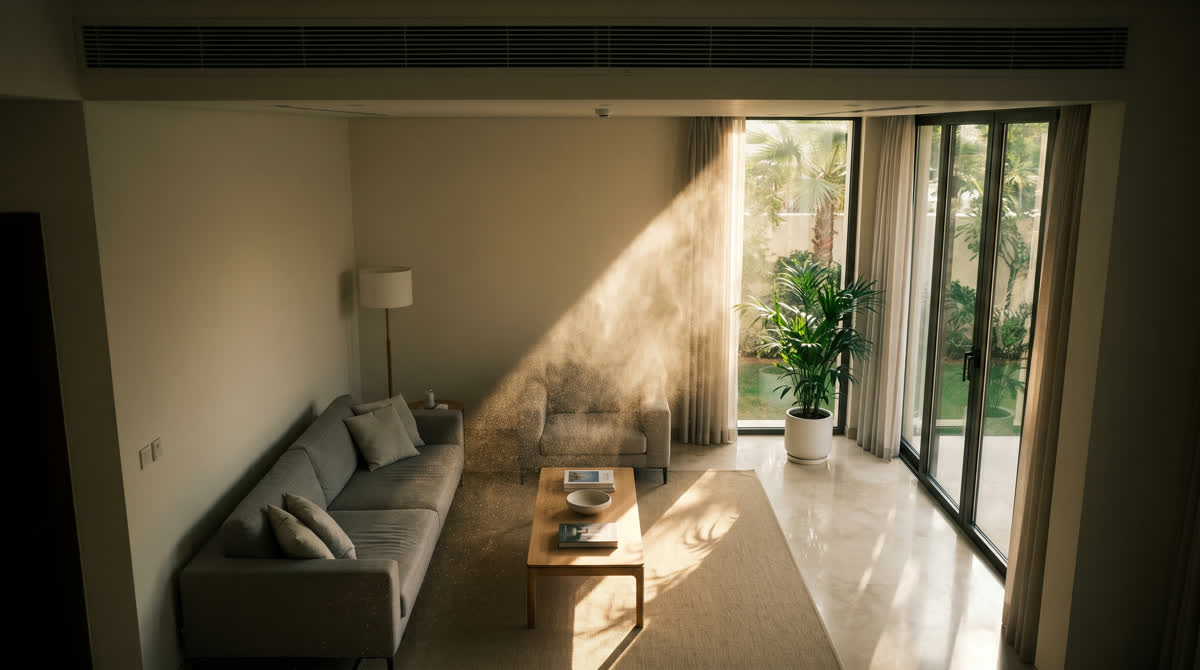
You paid for a professional duct clean, and a week later there is dust on the coffee table again, maybe even a thin stream of it when the AC starts. A resident in the UAE described exactly this on Reddit: full professional duct cleaning done, and still no idea where all the dust and fibre was coming from1. One reply, from someone working in the trade, guessed that the blower and the deep main ducts had simply not been reached. That is often the answer, but not always. This guide goes through the five places a duct clean most often misses, shows you how to check each one yourself, and then covers the other possibility: that the dust is not coming from the AC at all.
Is some dust after duct cleaning normal?
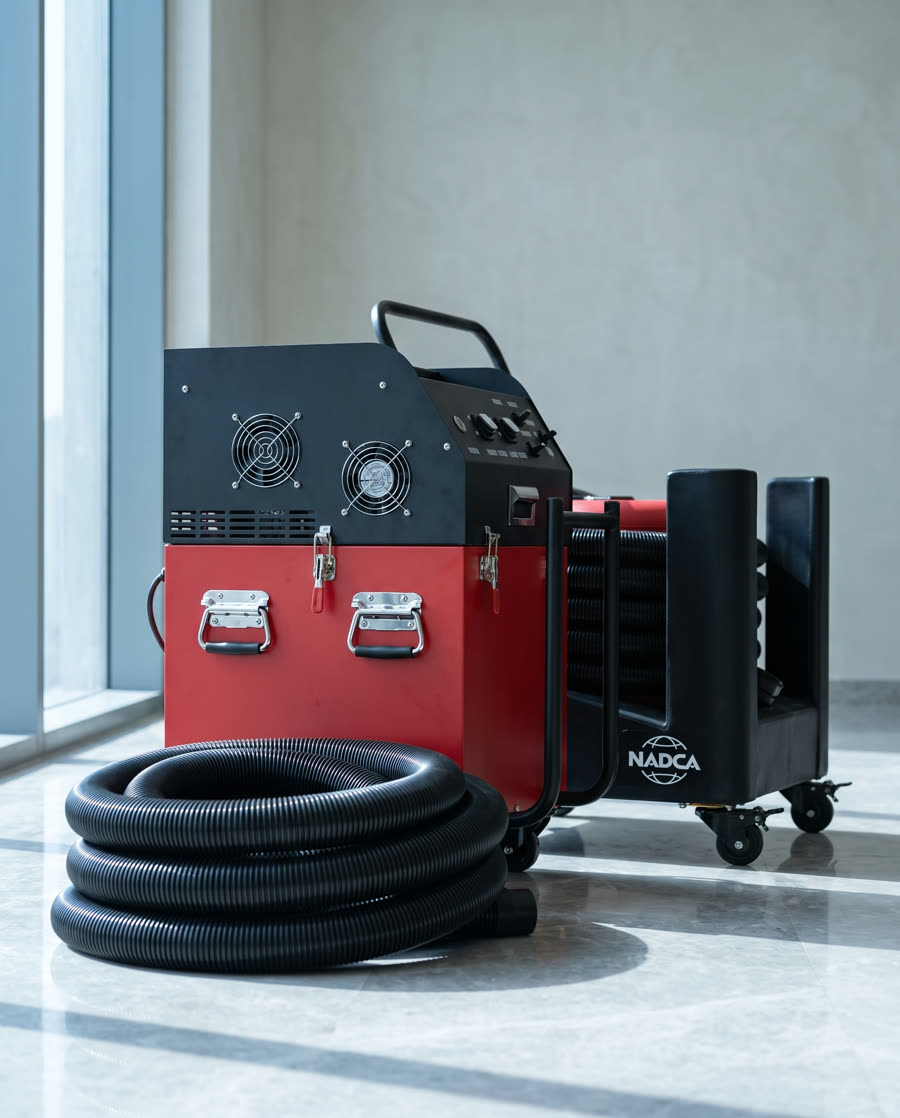
A little settled dust on the day can happen, especially where grilles were taken down. Dust that still blows out of the grilles days later is not normal. A proper duct clean runs suction under negative pressure the whole time anything is being loosened, so loosened dust is pulled out of the system rather than left in it2.
It also helps to set the right expectation. No home in Dubai is dust free. In our own averaging of three years of hourly Copernicus data, coarse particulate (PM10) in Dubai’s outdoor air sat above 50 µg/m³ in 80.5 percent of all hours, with an annual mean of 97.0 µg/m³3. A good duct clean means less dust and no dust blowing from the grilles. It does not mean surfaces that stay clean for a month.
Two quick tests tell you which situation you are in:
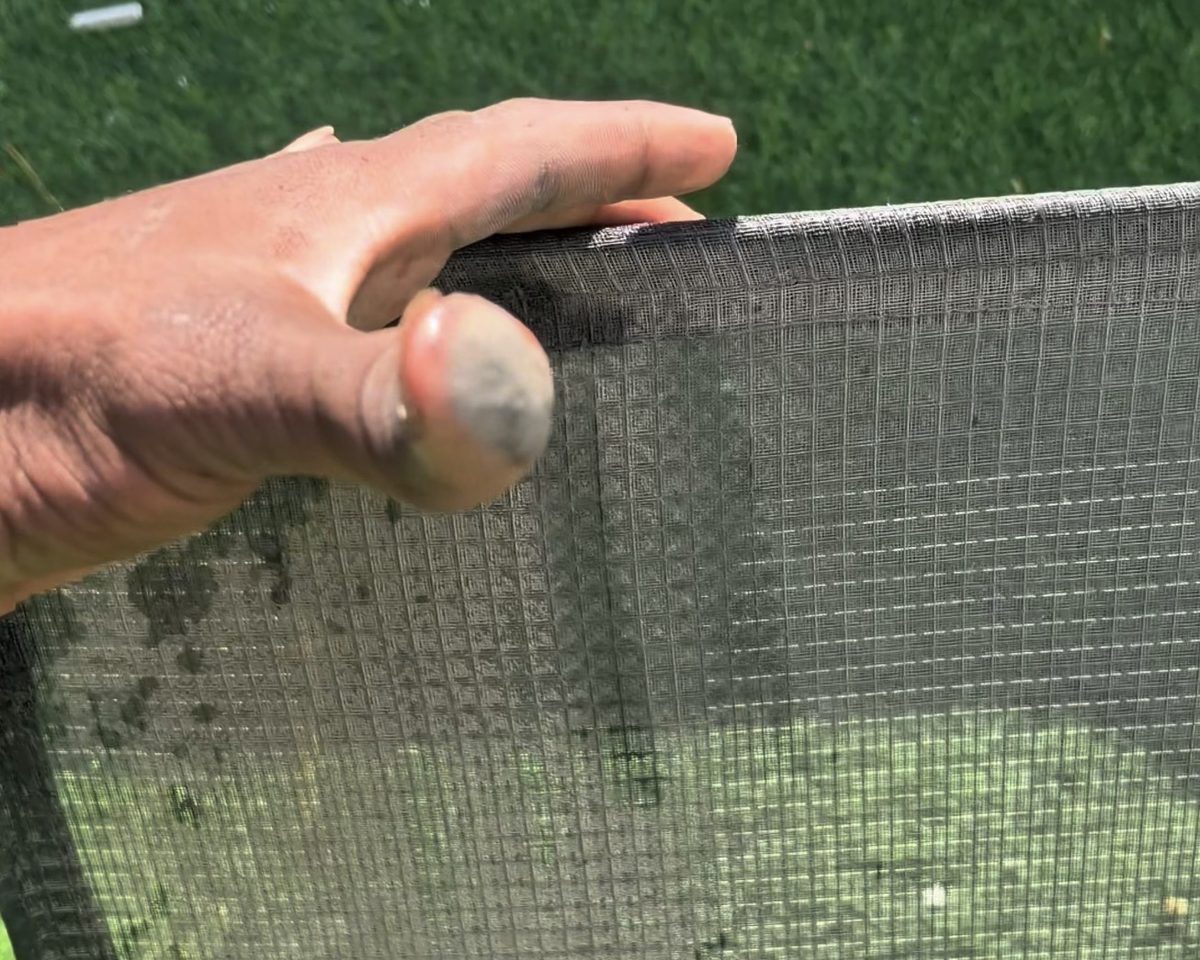
- The paper test. Start the AC, wait a minute, then hold a sheet of white paper a few centimetres in front of each grille for another minute. Grey specks on the paper mean dust is travelling in the air stream. Note which grilles belong to which unit.
- The wipe test. Wipe two surfaces clean in the evening: one close to a grille, one close to a sliding door or window. Compare them the next evening. More dust near the grille points to the system. More near the door points to the outside.
Which five places are most often missed?
The parts that need the unit opened or an access opening cut. Ducts can be reached from the grilles with a hose, so they look cleaned. The parts upstream of them often are not. The NADCA standard lists the air handling unit or fan coil, the blower and the removal of outlets as part of the work, not as extras2.
| Place | Why it gets missed | What you notice | How to check |
|---|---|---|---|
| 1. Blower wheel | Needs the unit opened; a duct brush does not reach it | Grey flakes from every grille on that unit, worst at start up | Torch through the outlet of the unit; the blades should be clearly visible |
| 2. Main duct and supply plenum | The box right after the unit is only reachable through an access opening | Dust from all outlets on one unit, even after the branches were cleaned | Ask where the access openings were made |
| 3. Return air path | Air flows into it, so it is easy to forget; it can be a grille, a duct or the ceiling void | Dust on the face of the return grille, dust around the filter | Look at the return grille and the filter a week after the clean |
| 4. Inside the grilles and diffusers | Wiped in place instead of taken down | Dark halo on the ceiling, puffs of dust at the louvres | Torch behind the louvres and into the neck of the diffuser |
| 5. Filter seat | Filter refitted crooked, or a warped frame leaves a gap | Dust reaches the coil and ducts again soon after the clean | Check all four edges of the filter for gaps |
1. The blower wheel
The blower wheel sits inside the unit and has many curved blades, each of which collects a layer of fine dust. When the blades are coated, the wheel sheds that layer into the air stream, especially when the unit starts. Cleaning the casing around it changes nothing. If the grilles of one unit all blow dust and the others do not, look here first.
2. The main duct and supply plenum
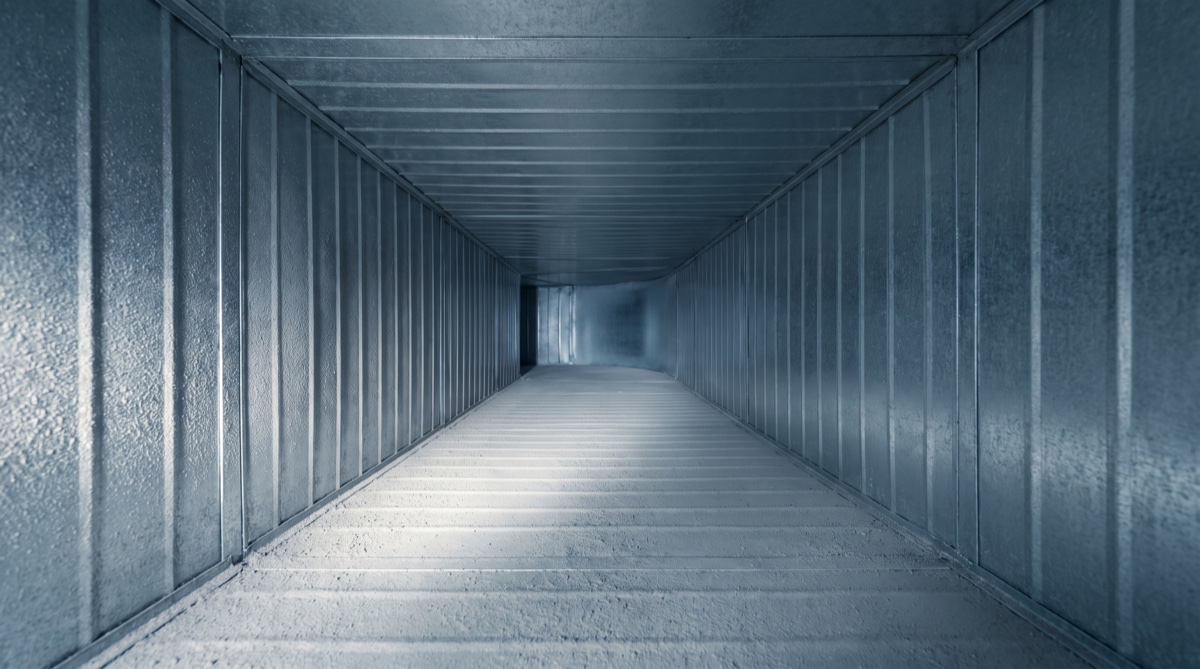
The plenum is the box or first section of duct right after the unit, where the air splits into the branch ducts. It takes the full air stream and holds whatever passed the filter. Cleaning from the grilles inwards reaches the ends of the branches, not the plenum. The NADCA method uses access openings and agitation followed by suction for exactly this reason2.
3. The return air path
Every system draws air back through a return grille, and in many apartments the return runs through a short duct or through the space above the false ceiling. Renovation dust, ceiling board dust and sand settle there. Because air is pulled into the return rather than blown out, it rarely looks dirty from the room, yet everything in it travels to the filter and, through any gap, beyond.
4. Inside the grilles and diffusers
Dust packs behind the louvres and in the neck where the diffuser meets the duct. Wiping the visible face leaves all of that in place, and the next air stream carries it out. Grilles should come down and be washed away from the room.
5. The filter seat
A clean filter only works if all the air goes through it. A filter pushed back crooked, a frame that has warped or a missing clip leaves a gap, and unfiltered air takes the easy route. The US Department of Energy suggests checking filters every one to two months in the cooling season4, which in Dubai covers most of the year. Check the edges as well as the filter itself. On request we fit a triple filter where the unit allows it, which then has to be cleaned on schedule so it does not restrict the airflow.
How do you tell system dust from outside dust?
By where it lands and what it looks like. Use the table together with the two tests above.
| What you see | Points to the AC system | Points to air leaking in |
|---|---|---|
| Specks on paper held at the grille | Yes | |
| Dust heaviest around grilles and on the ceiling next to them | Yes | |
| Grey fluff or flakes after the AC starts | Yes, often the blower or the return | |
| Gritty, sandy dust heaviest near sliding doors and windows | Yes | |
| More dust after windy or hazy days | Yes | |
| Dark lines along carpet edges and under doors | Yes, air pulled through gaps | |
| Sand in door tracks and on window sills | Yes |
Gritty dust is typical for Dubai. A 2023 study of indoor dust from twenty Dubai homes found it largely mineral, with calcium alone at an average of 14,170 mg/kg5. That kind of dust usually comes in from outside rather than out of a recently cleaned duct.
Where does dust get in from outside the AC?
Through every gap where air can move, and in Dubai the outdoor air carries a lot of it. In the same Copernicus averages, PM10 reached 170.8 µg/m³ in July and 178.2 µg/m³ in August, against 54.3 µg/m³ in January3. If the dust appeared after the summer, the season alone may explain part of it.
The usual entry points:
- Sliding doors. Worn brush seals and sand in the tracks let dust in and get it carried across the floor. Tracks should be vacuumed, not swept, and seals checked.
- Windows. Gaps at the frame and failed seals, most noticeable on the windward side of the building.
- The entrance door. When the kitchen hood or bathroom fans run, they pull air in through the easiest gap, often under the front door.
- The building’s fresh air supply. Many towers feed treated outdoor air into each apartment. Dubai Municipality’s guideline asks for “proper shielding of outdoor air intakes to prevent entry of wind driven rain and sandstorms”6. That intake is the building’s equipment, not yours.
- Soft furnishings. Sofas, rugs and curtains store dust and release it when you sit, walk or draw them. Dark lines along carpet edges are known as filtration soiling, a condition the IICRC upholstery standard lists among the things to record before cleaning7. They form where air is pushed through the carpet edge, which makes them a useful map of where air leaks in.
What should you do, and in which order?
Work from the cheapest check to the most expensive fix:
- Clean or replace the filter and check that it sits flush.
- Do the paper test at every grille and write down which units show dust.
- For those units, look at the blower wheel with a torch and at the return grille.
- Do the wipe test near grilles and near doors and windows.
- If the system is the source, ask the company that did the duct clean which parts were cleaned and through which access openings. The EPA’s checklist for a finished duct job is a good basis for that conversation, including whether the coil and drain pan were cleaned8.
- If the outside is the source, have seals and door brushes checked, and clean what the dust has already reached: tracks, sills, upholstery and rugs.
If you want to know what the full job should have included, what a proper AC deep clean looks like, step by step walks through the sequence. And if the dust arrived with a storm, after a sandstorm: what to clean in the first 48 hours has the order that keeps it from spreading.
Who is responsible for fixing it?
It depends on where the dust comes from. Parts that were paid for and not cleaned are a matter for the company that did the job. Most will come back if you show them photos and name the part.
Seals, door brushes and the building’s fresh air system are usually the owner’s or the building’s responsibility. Dubai Law No. 5 of 2025 places a continuing obligation on owners of a built environment to carry out cleaning, measure indoor air quality and keep it within acceptable limits9. Who pays for which repair in your flat is decided by your tenancy contract, and disagreements go to the Rental Dispute Center. This is general information, not legal advice.
What a cleaning company can do is the rest. Our AC cleaning in Dubai covers the unit, blower, coil, tray, drain and grilles with our own technician, and the ducts when an inspection shows they need it. A home deep clean on the same visit takes the dust that is already in the room, including door tracks, and carpet cleaning deals with the dust stored in rugs and along their edges. Whether the ducts need another clean at all is a separate question, answered honestly in is AC duct cleaning worth it.