
You look up and see it: a dark ring on the ceiling around the AC diffuser, or black dots along the slats of the grille. The first thought is mould, the second is whether you have been breathing it. Before you book anything or call the landlord, it helps to know that three quite different things cause black marks around AC vents in Dubai, often together: dust carried by the airflow, condensation on a surface colder than the room, and growth on a surface that stays damp. They look similar from the sofa and very different from a ladder.
Is the black stuff around my AC vent mould?
Sometimes, but not always, and often only partly. Many dark rings around ceiling diffusers are dust deposits, shaped by the air leaving the grille. Many black dots on slats are dust that got wet and dried again. Growth is possible wherever a surface stays damp, and around a cold grille in Dubai that happens more easily than in most places.
Nobody can identify mould reliably from a photo, us included. Only a sample analysed by a laboratory can say for certain what a mark is. What you can do from a ladder is narrow it down, and that is usually enough to decide what to do next.
How can you tell dust, condensation and mould apart?
Look at the shape, touch it with a dry tissue, and check again after a few weeks. This table describes the typical appearance of each cause.
| What you see | Where it sits | Dry tissue test | Comes back after cleaning | Most likely cause |
|---|---|---|---|---|
| Even grey to black halo in the shape of the airflow | Ceiling paint around a diffuser, a few centimetres wide | Smears off easily, grey on the tissue | Slowly, over months | Dust carried and deposited by the airflow |
| Drops of water, wet streaks, drip marks on the wall or floor below | Grille slats and frame, ceiling right next to the grille | Wet | Every hot, humid day | Condensation: the grille is colder than the room’s dew point |
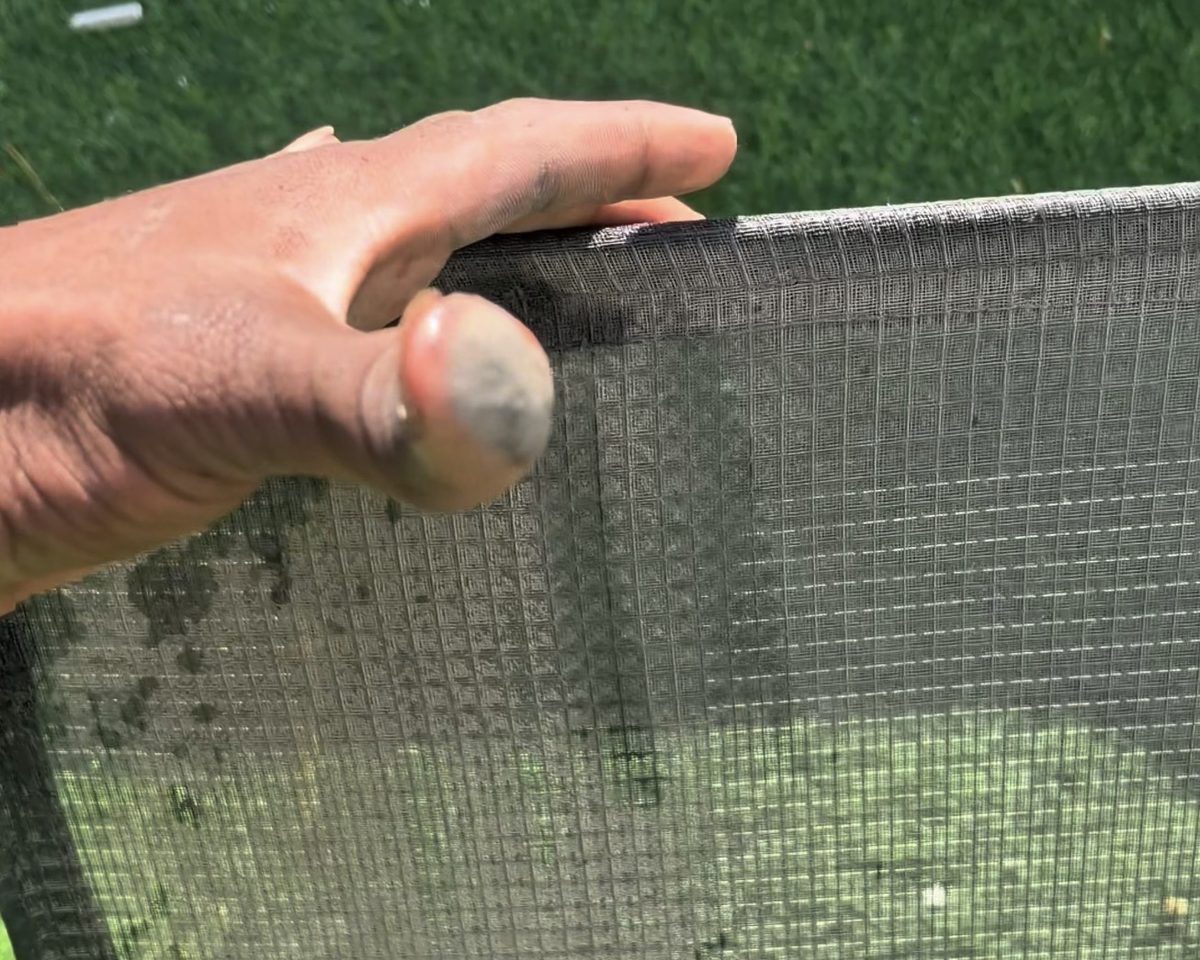
| Small black dots on the slats, gritty when dry | Slats and inner edges of the grille | Partly wipes off, leaves stains | Within weeks | Dust that has been wetted by condensation and dried |
| Fuzzy or speckled spots, black, dark green or brown, often with a musty smell | Corners of the grille, inside the collar, on the ceiling where it stays damp | Does not lift cleanly, leaves a stain | Within weeks | Growth on a damp surface |
| Black flakes landing on furniture or the floor under the vent | Below the grille | Loose, dry particles | After the AC runs | Debris from the blower or the duct |
| Brown or rust coloured streaks | Grille frame, screws, tray edge | Stains | Stays | Corrosion, a repair question |
If two rows fit, both causes are probably at work. That is common: condensation provides the water, the airflow provides the dust, and the combination provides the conditions for growth.
Why does condensation form on AC grilles in Dubai?
Because the air leaving the grille is cold, the grille cools down with it, and Dubai’s air holds a lot of water. When the surface of the grille drops below the dew point of the air around it, water condenses on it.
Outdoors, the dew point in Dubai sits at or above 24 °C in 54 percent of hours in July and 53 percent in September, according to our analysis of ten years of ERA5 data2. Indoors it should be far lower, because the AC removes water from the air. It rises whenever humid outdoor air gets in: a balcony door left open, a worn door seal, a bathroom fan pulling air through gaps, or a unit that cools quickly but runs too briefly to remove moisture.
Dubai Municipality’s indoor air guideline recommends keeping relative humidity “below 60%”, and its comfort table adds “Never to exceed 56%RH at 80F (27C)”1. A simple hygrometer from a hardware shop shows whether your room is above that. If it regularly is, the black marks are a symptom, and the humidity is the cause. We look at that problem in more detail in why your apartment is humid even with the AC on.
Why do dark rings form even without mould?
Because the air leaving a diffuser carries fine particles, and part of them settle on the ceiling surface right next to the outlet. The ring takes the shape of the airflow, which is why it often looks so regular. Carpet cleaners know the same effect along skirting boards, where air pushed through the carpet edge leaves dark lines, and call it filtration soiling.
In Dubai the particles are largely mineral. A 2023 study of indoor dust in Dubai homes found calcium alone at an average of 14,170 mg/kg3. That matters for cleaning: mineral dust is abrasive, so scrubbing a dry ring on matt ceiling paint can leave a shiny, scuffed patch that looks worse than the ring.
A dust ring is mostly a sign that air, and whatever it carries, is passing the filter. A filter that is clogged, missing, badly fitted or bypassed lets more through. The filter is the first thing to check.
What can you safely do yourself?
Clean the grille face, check the filter and measure the humidity. Leave the inside of the unit to someone who can open it properly.
- Switch the unit off at the thermostat before you start, so the fan does not blow loosened material into the room.
- Do not dry brush or vacuum the marks with a brush head. It spreads the material into the room and scuffs ceiling paint.
- Wipe with a damp microfibre cloth and a few drops of mild detergent in water. Fold the cloth often. Lay a sheet on the floor or furniture below.
- Take down removable grilles and wash them in the sink or shower, then dry them fully before refitting.
- Dry everything. Leaving a grille damp is the opposite of what you want.
- Check the filter. Wash or replace it if it is grey or matted, and check that it fits without gaps.
- Measure humidity for a few days, morning and evening, with doors and windows closed.
- Keep balcony doors closed while the AC runs, especially from June to September.
What not to do: do not spray bleach or household sprays into the unit or the duct. Fumes and liquid go where you cannot rinse them off, and the US EPA notes that “no chemical biocides are currently registered by EPA for use in internally-insulated air duct systems”5. And do not paint over the marks before you know why they are there.
We make no promises about health here, and neither should anyone selling you a clean. What the World Health Organization recommends in its guidelines on dampness and mould is simple and sensible: prevent persistent damp and microbial growth in buildings, or keep it to a minimum4. Removing the moisture source does more for that than any spray.
When is it a job for a professional AC clean?
When the marks come back within weeks, sit behind the grille rather than on it, or come with a smell, drips or flakes. Those signs point into the unit: a wet coil, a tray that does not drain, a blower wheel coated in damp dust.
Signs that you need more than a cloth:
- Black spots are visible inside the grille collar or on the blower wheel when you shine a torch up through the grille.
- The unit smells musty when it starts.
- Water drips from the grille or the access panel.
- Black flakes land on surfaces below the vent.
- The marks return within a few weeks of a careful clean and the humidity is under control.
A proper AC clean covers the coil, the condensate tray and drain, the blower and the grilles, with the drain tested before and after, as described on our AC cleaning service in Dubai page, and the same on our AC cleaning in Sharjah page. Dubai Municipality gives trays and coils the shortest intervals of the whole system, monthly and six monthly1, for exactly this reason. Duct cleaning is rarely the first step for marks at the grille. When it is the right one is explained in is AC duct cleaning worth it.
When is it the landlord’s or the building’s job?
When the cause is in the building rather than on the surface. A cleaning company can remove what has grown on a grille. It cannot fix a ceiling that stays wet.
Signs that the cause belongs to the building:
- Ceiling boards around the grille are stained, soft or swollen.
- Chilled water pipes or their insulation above the ceiling drip or feel wet.
- The drain line is broken or the tray is cracked, not just blocked.
- Condensation forms even with doors closed and the humidity in range, which can point to a design or insulation fault.
- Growth has spread into insulation or ceiling board. Dubai Municipality advises to “discard furniture, carpet, or similar porous material having a persistent musty odor”1. That is replacement, not cleaning.
Dubai’s public health law, Law No. 5 of 2025, places duties on the “Owner”, which it defines as a person who “owns or has actual control over the Built Environment or any part thereof”6. Article 33 lists among them continuous cleaning, keeping indoor air quality within acceptable limits, responding immediately to health risks and periodic maintenance6. How those duties split between landlord and tenant in a rented flat depends on your tenancy contract and building rules. Report the problem to your landlord or building management in writing, with photos and dates. If you cannot agree, the Rental Dispute Settlement Centre is the place for disputes in Dubai. This is general information, not legal advice.
The order that works: the building fixes the moisture source, then the unit and grilles are cleaned, then the ceiling is repainted. Done the other way round, the black spots are usually back by the next humid season.