
The storm has passed, the sky is turning blue again, and there is a fine beige film on the balcony table, the window sills, the TV and probably the pillows. The instinct is to grab a cloth and wipe. In Dubai that is the one thing worth not doing, because this dust is ground rock, not lint. Here is what to clean in the first two days, in an order that avoids doing it twice, and why the method matters as much as the speed.
Why is sandstorm dust different from normal household dust?
Because it is mineral and abrasive. A 2023 study analysed indoor dust from homes in Dubai and found calcium at an average of 14,170 mg/kg, potassium at 9,159, magnesium at 1,876, aluminium at 1,034 and iron at 9971. The authors relate those levels to the geology of the Arabian Peninsula and to dust carried in from outside1.
In practice, what lands on your furniture after a storm is closer to very fine sand than to the soft grey fluff of a European flat. Dragged across glass, a lacquered sideboard, a stainless steel fridge or a TV screen with a dry cloth, it scratches. The damage is invisible after one wipe and obvious after a year: surfaces that look dull and hazy even when clean. That is why every step below either lifts the dust first or wets it before it moves.
When is the dust worst in Dubai: storms or summer?
Both, and they are two different things. Visible dust events and dust storms happen in distinct seasons. A long term study of four UAE stations from 1983 to 2014 found dust events clustering in March and April and dust storms more frequent in winter, with events lasting 2 to 5 hours and storms 5 to 11 hours, and about 90 percent of episodes coming from the southwest2.
The total amount of dust in the air, however, peaks later. We averaged three years of hourly Copernicus data for Dubai by month, and the result surprises most people3:
| Month | PM10 (µg/m³) | of which mineral dust (µg/m³) |
|---|---|---|
| January | 54.3 | 34.3 |
| March | 83.6 | 72.1 |
| May | 82.8 | 73.1 |
| June | 107.0 | 115.9 |
| July | 170.8 | 228.2 |
| August | 178.2 | 245.1 |
| September | 123.4 | 141.2 |
| November | 60.6 | 36.7 |
Source: Copernicus CAMS reanalysis via Open-Meteo, hourly values 09/2022 to 08/2025, monthly means, own analysis3. Mineral dust is a separate model output in CAMS and is not directly comparable with the PM10 column.
So a spring storm is a single heavy event you clean up after. The summer shamal in July and August is a steady load that settles every day, at roughly three times the January level. If you open windows during those months, plan for a thorough clean in September regardless of storms.
What should you do while the storm is still blowing?
Keep everything shut and let the building do its job. Close windows and balcony doors, keep the AC running with its filters in place, and do not start cleaning yet. Every pass you make while dust is still in the air gets coated again within the hour.
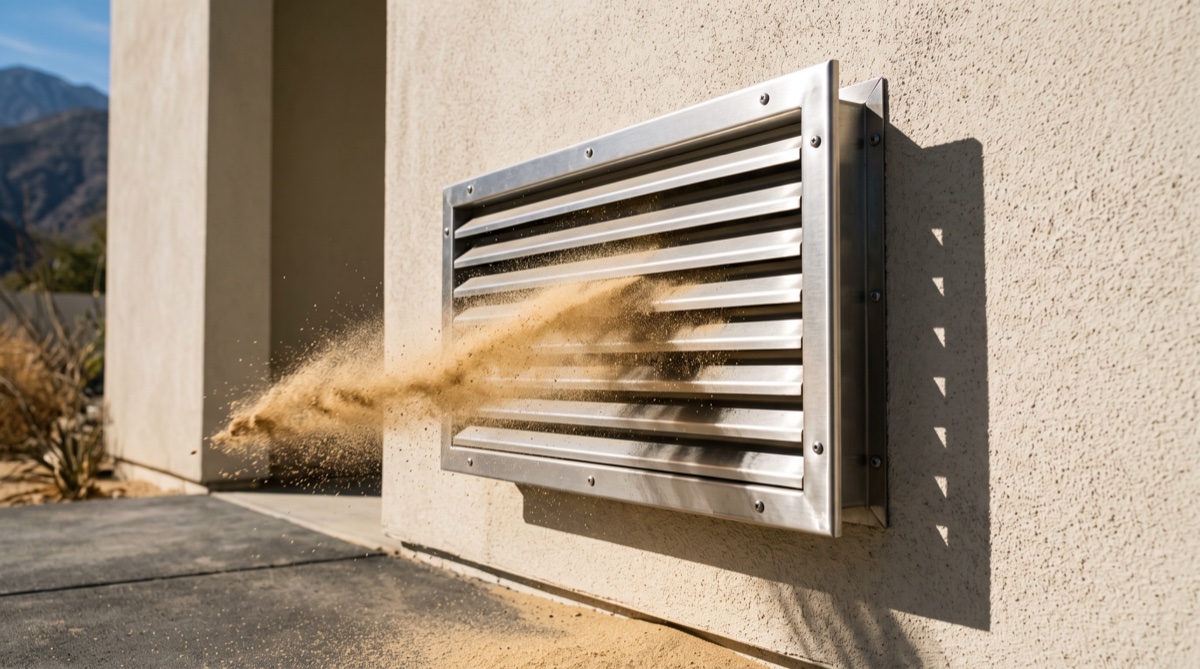
Dubai Municipality treats sandstorms as a building maintenance matter. Its indoor air quality guideline calls for “proper shielding of outdoor air intakes to prevent entry of wind driven rain and sandstorms”4. That part is the building’s responsibility. Yours is the gaps: a balcony door that does not close tightly or a window left on tilt.
In which order should you clean after a sandstorm?
Outside before inside, top to bottom, dry before wet. The order prevents you from moving dust onto surfaces you have already done.
| Step | What to clean | How | Why this point in the order |
|---|---|---|---|
| 1 | Balcony and terrace floor, furniture, cushions | Sweep or vacuum dry, then rinse or mop; bring cushions in to vacuum | Otherwise sand is walked inside all day |
| 2 | Sliding door tracks and window channels | Vacuum with a crevice tool, then a damp cloth; clear the drain holes | Sand in tracks grinds rollers and stops doors closing tightly |
| 3 | AC filters | Take out, vacuum or rinse, let them dry fully, refit | The filter caught the most; a clogged one restricts airflow |
| 4 | High surfaces: light fittings, top of wardrobes, curtain rails, AC grilles | Vacuum with a soft brush attachment | Dust falls down, so start up high |
| 5 | Curtains and blinds | Vacuum in place from top to bottom | They act as a filter beside open windows |
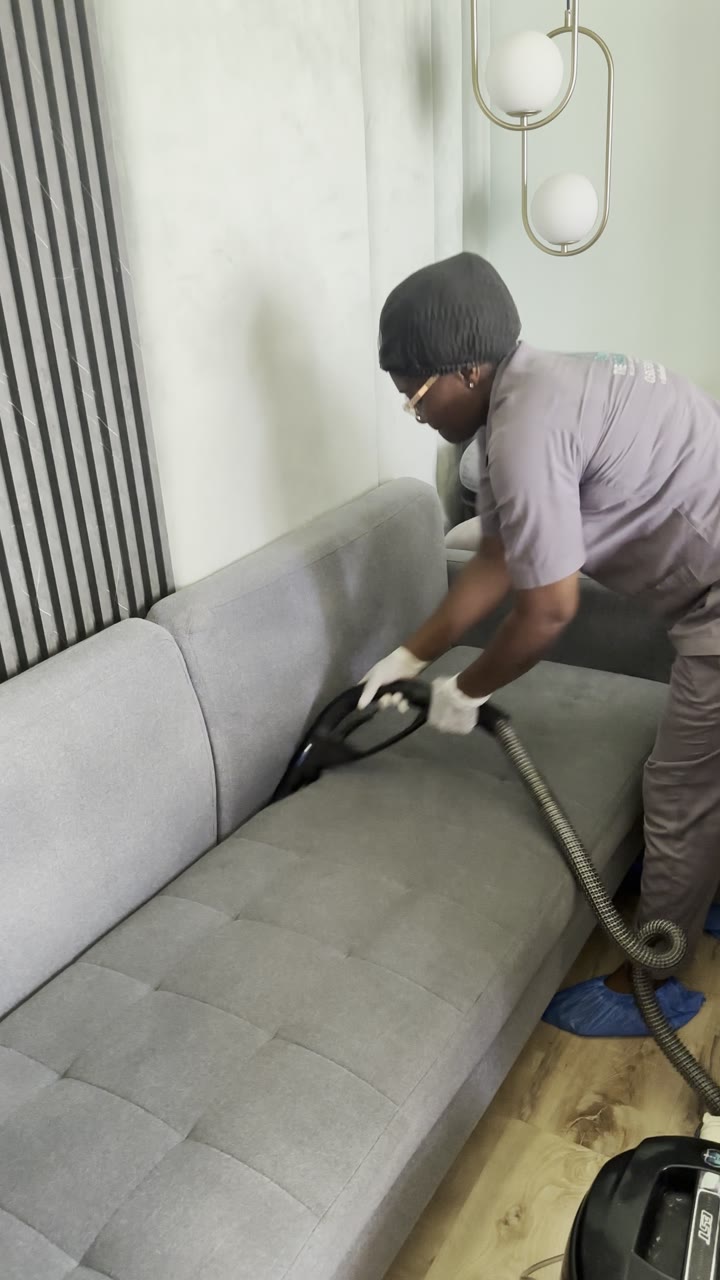
| 6 | Sofas, cushions, beds, rugs | Slow vacuum on all sides | Fine dust settles into the weave |
| 7 | Hard surfaces: tables, shelves, electronics, glass | Vacuum or soft brush first, then damp microfibre, rinsed often | Lift, then wipe, never drag |
| 8 | Floors | Vacuum first, then a damp mop with clean water changed often | Last, because everything above lands here |
Two notes on the outside steps. Do not hose large amounts of sand from the balcony into the floor drain, because sand settles in the pipe; sweep it up and bin it, then rinse. And if your sliding doors run heavily after a storm, the cause is almost always sand in the bottom track rather than a broken roller.
Why should you never wipe the dust off dry?
Because dry wiping turns mineral dust into an abrasive. The same particles that make Dubai dust so heavy1 are what scratch glass, polished stone and lacquer when they are pushed across them.
The safe method is two steps. First lift the loose dust without pressure, with a vacuum and a soft brush attachment or a dry, soft brush into a dustpan. Then wipe with a damp microfibre cloth, folded so you always work with a clean side, rinsed often in clean water. For screens, use only a barely damp cloth and no pressure. For marble and other natural stone, avoid acidic cleaners such as vinegar, which etch the surface.
What about the air conditioning?
Check the filters within a day or two, and look at the grilles. The filter is designed to catch exactly this dust, and after a storm it often catches a lot. The US Department of Energy states that replacing a dirty, clogged filter with a clean one can lower an air conditioner’s energy consumption by 5 to 15 percent5.
If you clean the filters and the grilles still blow dust after a day, dust has passed into the unit or onto the coil. That is a job for a proper AC cleaning, which covers filter, coil, condensate tray and drain, and grilles. It is rarely a reason for duct cleaning on its own. Our guide on how often AC ducts really need cleaning in Dubai explains the difference between what Dubai Municipality asks for and what is often sold.
Is the air in your apartment safe after a sandstorm?
That is a question for the health authorities and your doctor, not for a cleaning company, but two facts help to read the numbers you see in the news. The World Health Organization’s 2021 air quality guidelines set a 24 hour level for PM10 of 45 µg/m³6. The WHO itself, however, excludes particles from sand and dust storms, “for which there is insufficient quantitative evidence to derive AQG levels”7. Its guideline values were derived for combustion pollution, not for desert dust.
For indoor air, Dubai Municipality’s guideline gives a 24 hour limit of 150 µg/m³ for PM10 in existing buildings4. Keeping windows closed during a storm and cleaning the dust out afterwards keeps the indoor load down, which is the part you can influence. If anyone in your household has asthma or another respiratory condition, follow your doctor’s advice for dust events.
When is it worth calling in professionals?
When the storm got in. A light storm with closed windows is a job for an evening with a vacuum and a damp cloth. It is worth booking help in these cases:
- Windows or balcony doors were open, and dust is on every surface, inside cupboards and on textiles.
- Sofas, curtains and carpets look grey or feel gritty after vacuuming. Our sofa cleaning and carpet cleaning use extraction suited to the fabric.
- The AC keeps blowing dust after you cleaned the filters.
- A villa with a large terrace, pool surround and high windows, where the outside alone takes a day.
A home deep clean covers the whole sequence above, inside cupboards included, and we agree a fixed price on WhatsApp before we start, with no extra charges on the day. Late summer is often the better moment for it than the day after a spring storm: by September, the heaviest dust months of the year are behind you3.