
You open the weather app, and next to 31 °C there is a small orange number: AQI 112. Yesterday it was yellow, in August it was red for days. Most people in Dubai have seen this, few know what the number actually measures, and even fewer know that it says nothing about the air in their own living room. This guide explains the index, shows what three years of data say about Dubai, and separates what you can change at home from what you cannot. If you are dealing with a sandstorm right now, our guide on what to clean after a sandstorm is the faster read.
What does the AQI number in your app actually mean?
It is a translation of pollutant levels into one number from 0 to 500, with colours. Most apps in the UAE show the US EPA scale or a version of it, so check which scale your app names. AirNow, the EPA’s air quality service, describes the index as “EPA’s tool for communicating about outdoor air quality and health”1.
| AQI | Colour | EPA category | What the EPA says |
|---|---|---|---|
| 0 to 50 | Green | Good | “Air quality is satisfactory, and air pollution poses little or no risk” |
| 51 to 100 | Yellow | Moderate | “Air quality is acceptable. However, there may be a risk for some people, particularly those who are unusually sensitive to air pollution” |
| 101 to 150 | Orange | Unhealthy for sensitive groups | “Members of sensitive groups may experience health effects. The general public is less likely to be affected” |
| 151 to 200 | Red | Unhealthy | “Some members of the general public may experience health effects; members of sensitive groups may experience more serious health effects” |
| 201 to 300 | Purple | Very unhealthy | “Health alert: The risk of health effects is increased for everyone” |
| 301 and higher | Maroon | Hazardous | “Health warning of emergency conditions: everyone is more likely to be affected” |
All quotes in the table are from AirNow1. The index is calculated per pollutant, and the highest one sets the number you see. In Dubai that is almost always particles: PM2.5, particles up to 2.5 micrometres, and PM10, up to 10 micrometres.
Three things are worth knowing before you read too much into one value:
- The scale is not a law in the UAE. It is a communication tool. In the US, the EPA tightened its own annual health standard for PM2.5 to 9.0 micrograms per cubic metre in 20247, which is why US apps turn yellow sooner than they used to.
- The WHO is stricter still. Its 2021 guideline levels are 15 µg/m³ for PM2.5 and 45 µg/m³ for PM10 as a 24 hour mean, and 5 and 15 µg/m³ as an annual mean. The 24 hour values are set as the 99th percentile, which allows three to four days above them per year, and the WHO states that its guidelines are applicable “to both outdoor and indoor environments”2.
- The number describes outdoor air. AirNow is explicit that it is about outdoor air quality1. Your bedroom can be much better or much worse.
How good is the air in Dubai, month by month?
Dust makes the difference, and summer is the worst season, not spring. We analysed hourly model data from the Copernicus Atmosphere Monitoring Service for central Dubai from January 2023 to December 2025, 1,096 days in total3. These are model values for one grid point, not readings from a station near your building, so treat them as the pattern rather than the exact figure for your street.
| Month | Mean PM2.5 (µg/m³) | Mean PM10 (µg/m³) | Days with hourly AQI above 100 |
|---|---|---|---|
| January | 28 | 54 | 30 % |
| February | 34 | 74 | 58 % |
| March | 39 | 84 | 72 % |
| April | 39 | 84 | 78 % |
| May | 38 | 83 | 85 % |
| June | 43 | 107 | 91 % |
| July | 57 | 171 | 100 % |
| August | 59 | 178 | 100 % |
| September | 49 | 140 | 97 % |
| October | 38 | 83 | 74 % |
| November | 35 | 60 | 58 % |
| December | 36 | 67 | 69 % |
Source: our analysis of CAMS data via Open-Meteo3.
What the table shows:
- PM10 in August is about three times the January level. Fine dust lifted by summer winds is the reason, and it matches what our team sees on balconies, window tracks and AC filters.
- The daily mean PM2.5 is above the WHO 24 hour guideline of 15 µg/m³ on 99 percent of days in this dataset, while the WHO allows three to four such days per year23. That sounds dramatic, and it is the reality across much of the Gulf, where natural dust sets a high base level.
- January and November are the cleanest months. That is also the best time to air a flat thoroughly or to do a big clean with open windows.
- Midday is slightly dustier than early morning. Averaged over all hours, modelled PM10 is about 92 µg/m³ around 5 to 6 am and about 111 µg/m³ around noon3. If you want fresh air, open the windows early.
Is the air inside your apartment better than outside?
For particles, usually yes, if nothing inside produces them. The US EPA states that “in homes without smoking or other strong particle sources, indoor PM would be expected to be the same as, or lower than, outdoor levels”5. It also lists what decides the indoor level: “outdoor levels, infiltration, types of ventilation and filtration systems used, indoor sources, and personal activities of occupants”5.
In a typical Dubai apartment that translates into four questions:
- How much outside air gets in? Leaky balcony doors, open windows and worn seals let fine dust in. The AC recirculates indoor air, and its filter catches part of it.
- How good and how clean is the AC filter? A clogged filter lets air bypass and moves less air. Dubai Municipality asks that filters “should be cleaned or replaced so that they are performing properly at all times and do not become clogged”4.
- What is lying on the surfaces? Dust on shelves, curtains, sofas and carpets is whirled up again every time someone walks, sits or opens the curtains.
- What do you produce inside? Cooking, frying, incense, candles and smoking are strong particle sources. People also produce carbon dioxide and moisture.
A cheap indoor monitor that shows PM2.5, carbon dioxide and humidity tells you more about your home than the app does. Compare it with the outdoor AQI on a few days and you see patterns, for example whether indoor dust rises on windy days or after cooking. It is not a reliable test of how airtight the flat is, because indoor sources and filters change the result too.
Which limits apply to indoor air in Dubai?
Dubai Municipality has its own indoor air guideline, and its limits are looser for particles than the WHO guideline, which applies indoors as well, but they exist. Table 2 of the guideline, for existing buildings, sets among others4:
| Parameter | Limit for existing buildings | Averaging time |
|---|---|---|
| PM2.5 | 35 µg/m³ | 24 hours |
| PM10 | 150 µg/m³ | 24 hours |
| Carbon dioxide | 800 ppm | 8 hours |
| Total volatile organic compounds (TVOC) | 0.6 mg/m³ | 8 hours |
| Formaldehyde | 0.01 ppm | 8 hours |
| Relative humidity (comfort range) | 20 to 60 % |
Source: Dubai Municipality, DM-HSD-GU119-IAQ, Tables 2 and 34. Elsewhere the same guideline advises: “Keep relative humidity below 60% (50%, if feasible, to control dust mites)”4.
Two points make these numbers useful at home. First, they show that indoor air is a matter of particles and gases and moisture together. A flat with perfect PM2.5 but 1,500 ppm carbon dioxide in the bedroom at night still has an air problem, just a different one. Second, the outdoor values in our table above are well above the indoor PM2.5 limit on many summer days. That means the building and its filters have real work to do. If your humidity regularly sits above 60 percent, our guide on why an apartment stays humid with the AC on goes through the causes.
Should you open the windows when the AQI is high?
No, not on dusty days. The common advice to “air the flat” assumes clean outside air. Dubai Municipality makes the same point in its guideline: ventilation “assumes that the outdoor air is cleaner than the indoor air. In many locations and for many contaminants, this is not the case, and insufficiently treated ventilation air can actually make IAQ worse”4.
Our rule of thumb from daily work, not a rule from the sources:
- AQI above 100 and visible haze: windows and balcony doors shut, AC on with clean filters, air only briefly if stale air or a high carbon dioxide reading makes it necessary.
- AQI in the moderate range: air briefly and fully, ideally early in the morning, then close again. A split AC only recirculates room air and brings in no fresh air, so a building with a filtered fresh air supply is the better answer.
- After cooking: run the kitchen extractor rather than opening the balcony door, especially in summer.
- During and after a dust event: keep everything shut until the haze has cleared, then clean in the right order, as described in our sandstorm guide.
What can cleaning change, and what can it not?
Cleaning removes the dust that has settled, the part that is whirled up again every time the room is used. It does not change the air outside, and it does not replace a suitable filter or a working AC. Dubai Municipality is clear about where the particles end up: larger particles “settle rapidly before they can be removed by filtration, so effective allergen control measures require washing sheets weekly, frequent vacuuming of carpets and furniture, and dusting and cleaning of hard surfaces”4.
| Where the dust is | What cleaning does | Where cleaning stops |
|---|---|---|
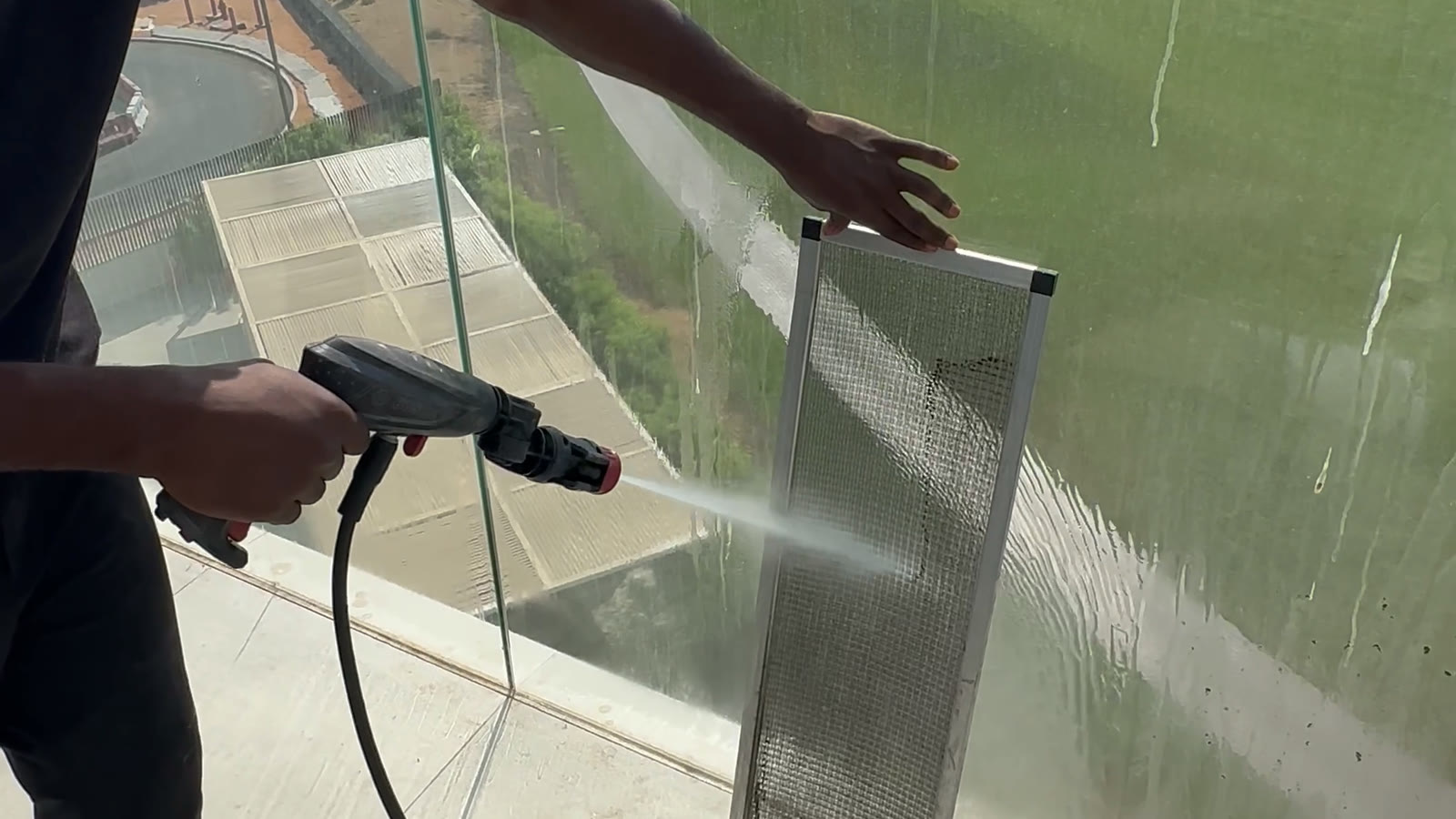
| AC return grilles and filters | Washes or replaces filters, cleans grilles | A filter class that is too low, a unit that leaks air past the filter |
| AC tray, coil and fan | Removes the sludge and dust where moisture collects | Damaged coils, broken drain lines, sweating pipes |
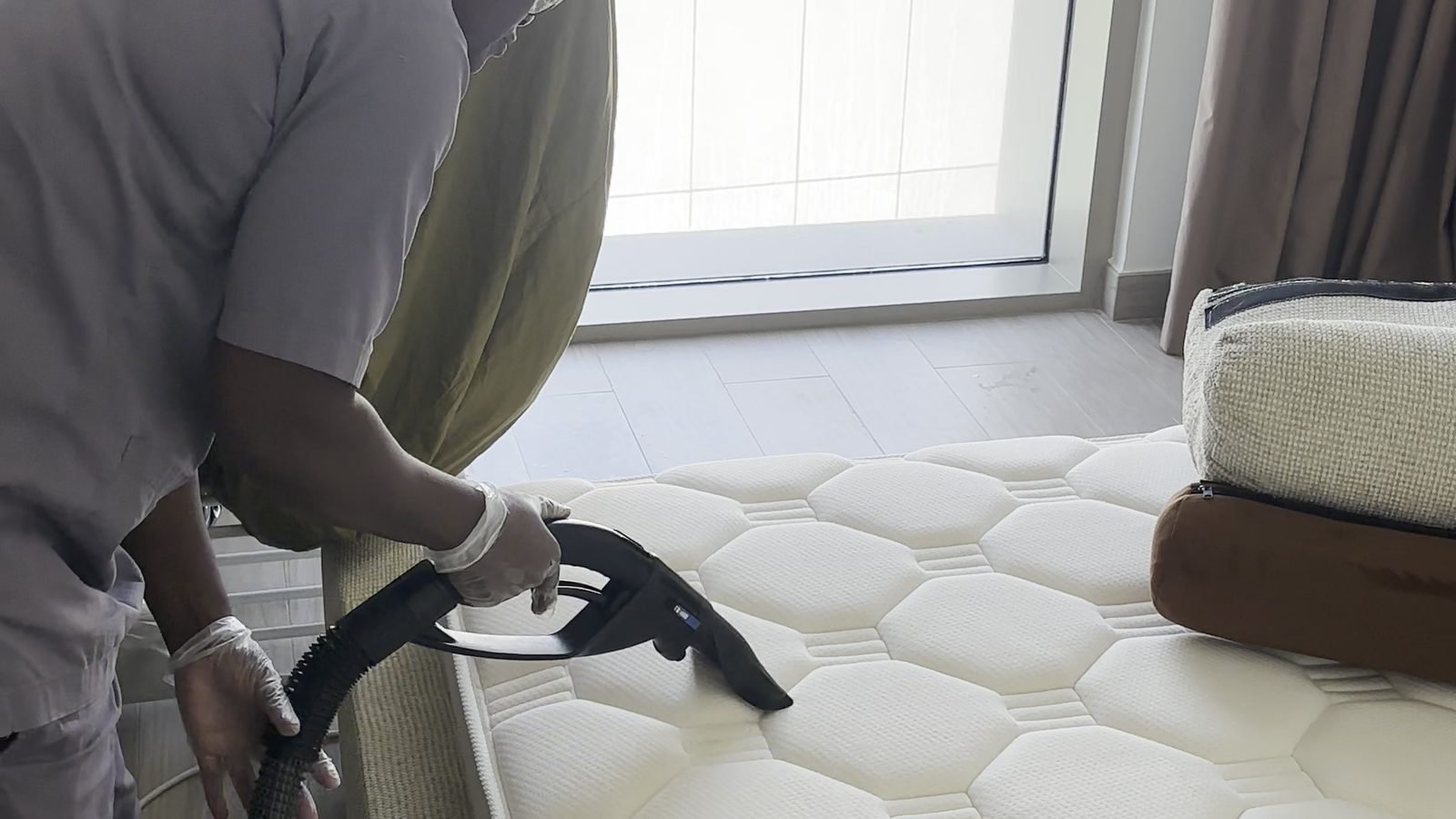
| Curtains, sofas, mattresses, carpets | Lifts the fine dust that is whirled up when you use them | Fabric that keeps shedding fibres or is worn out |
| Shelves, skirting, window sills, door tracks | Removes the dust layer, damp, not dry | New dust coming in through bad seals |
| Windows and balcony glass | Removes the film that makes rooms look grey | The haze outside |
| Indoor sources | Nothing | Frying without extraction, incense, smoking |
Three things we always tell clients:
- Vacuum with a good filter, then wipe damp. Dry dusting pushes fine dust back into the air. Our comparison of water filter, HEPA and cyclone vacuums explains which machine holds back fine dust.
- Clean the AC parts that collect moisture. Dubai Municipality asks for coils and condensate pipes to be cleaned “at least every six months” and trays “at least every one month” in building systems4. In a home, the realistic rhythm depends on the unit, and our guide on how often AC ducts should be cleaned sets out the intervals.
- Watch the humidity too. Dust mites thrive in damp fabric. Our article on dust mites in UAE homes shows what the research found.
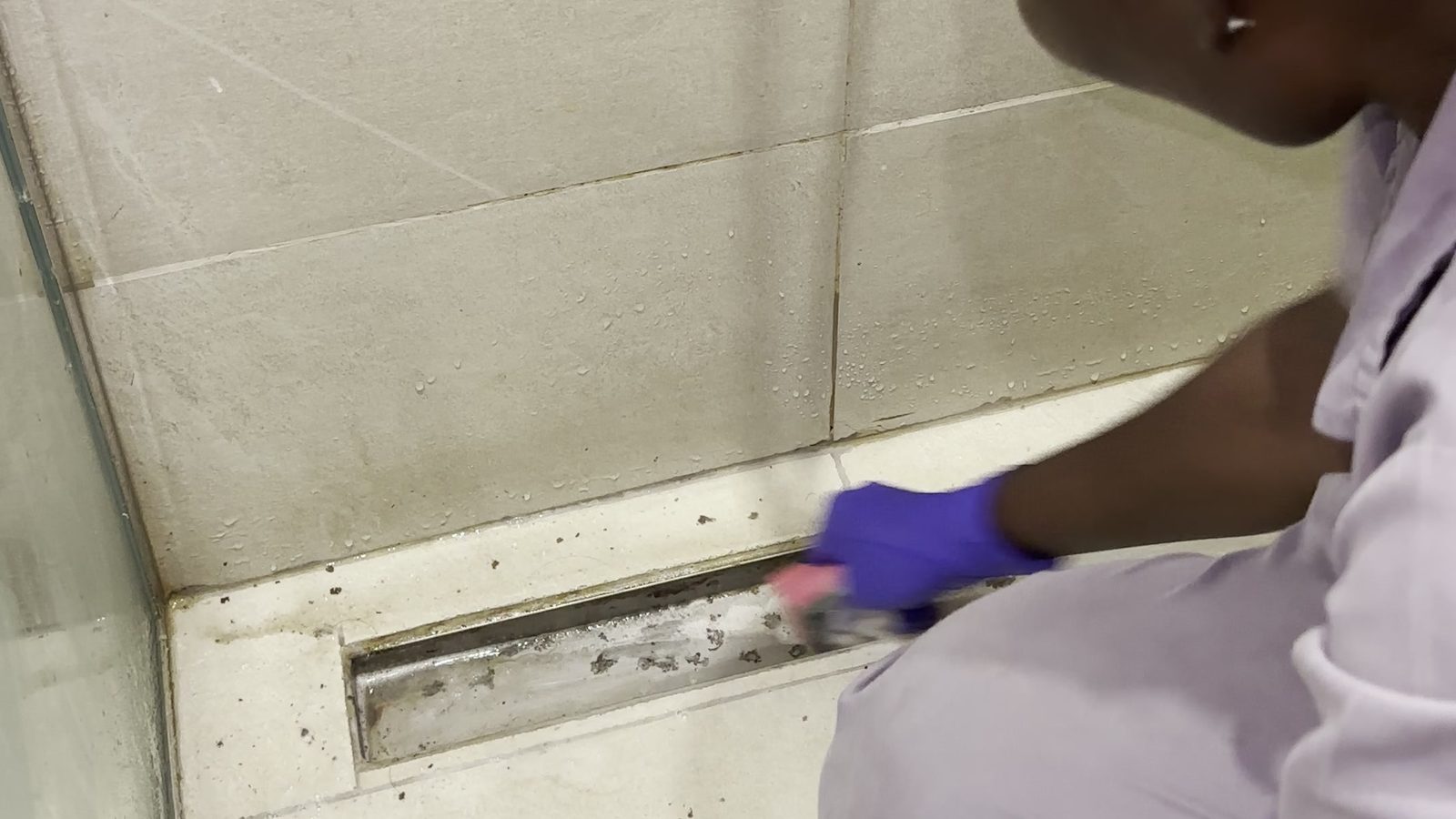
On a Healthy Home deep cleaning visit we work through these places in a fixed order: mattresses, sofas, carpets and curtains with HYLA water filtration, steam up to 180 °C where the fabric allows, every contact surface and every room from top to bottom. If you add the AC, our own technician cleans grilles, filter, coil and tray first, because opening the unit releases dust into the room. We describe what we do and make no health promises.
Do air purifiers and special filters help?
They can reduce fine particles in one room, if they are the right size, but they are a supplement and not a cure. The US EPA says to choose “a portable air cleaner that has a clean air delivery rate (CADR) that is large enough for the size of the room”, that such devices “often achieve a high CADR by using a high-efficiency particulate air (HEPA) filter”, and that “filtration does not replace the need to control pollutants and ventilate”6. On health effects the EPA is cautious: studies with portable HEPA cleaners showed improvements that “are typically small and not always noticeable to the individual”6.
Dubai Municipality adds a warning on one type of device: ozone generators “are not always safe and effective in controlling indoor air pollutants”, and ozone “may even react with existing chemicals in the air to create harmful by-products”4. The EPA likewise advises avoiding air cleaners that intentionally produce ozone6.
For the AC itself, ask your building or AC company which filter class is fitted. Dubai Municipality’s filter table places MERV 5 to 8 pleated filters at mould, spores and cement dust, MERV 13 to 16 at “all bacteria, most tobacco smoke”, and HEPA from MERV 17 upwards4. Whether a finer filter fits your unit is a question for a technician, because a filter that is too dense can choke the airflow.
A simple routine for the dusty months
- Check the AQI in the morning, not just the temperature, and keep windows shut on orange days with visible haze.
- Look at the AC filter every two to four weeks in summer. Wash it only if it is a washable filter, replace disposable filters as the manufacturer says and sooner when they are loaded with dust.
- Vacuum, then wipe damp, top to bottom, at least weekly in high dust months.
- Wash bedding weekly, as Dubai Municipality recommends for allergen control4.
- Keep humidity below 60 percent, a hygrometer costs little.
- Plan a deep clean for after the summer, when PM10 drops in October and November and you can air the flat properly again.
If you would rather hand over the hard part, our AC cleaning in Dubai covers grilles, filters, tray and coil, and the Healthy Home clean adds the fabrics and every surface on the same day.