
Search for a water filter vacuum in Dubai and you find two kinds of pages: dealers with percentages that nobody can check, and reviews that compare suction figures copied from a box. What is missing is the question that matters: where does the dust go once it is inside the machine, and how much of it comes back out? There is peer reviewed research on exactly that, and it is less flattering to every type of vacuum than any advertisement.
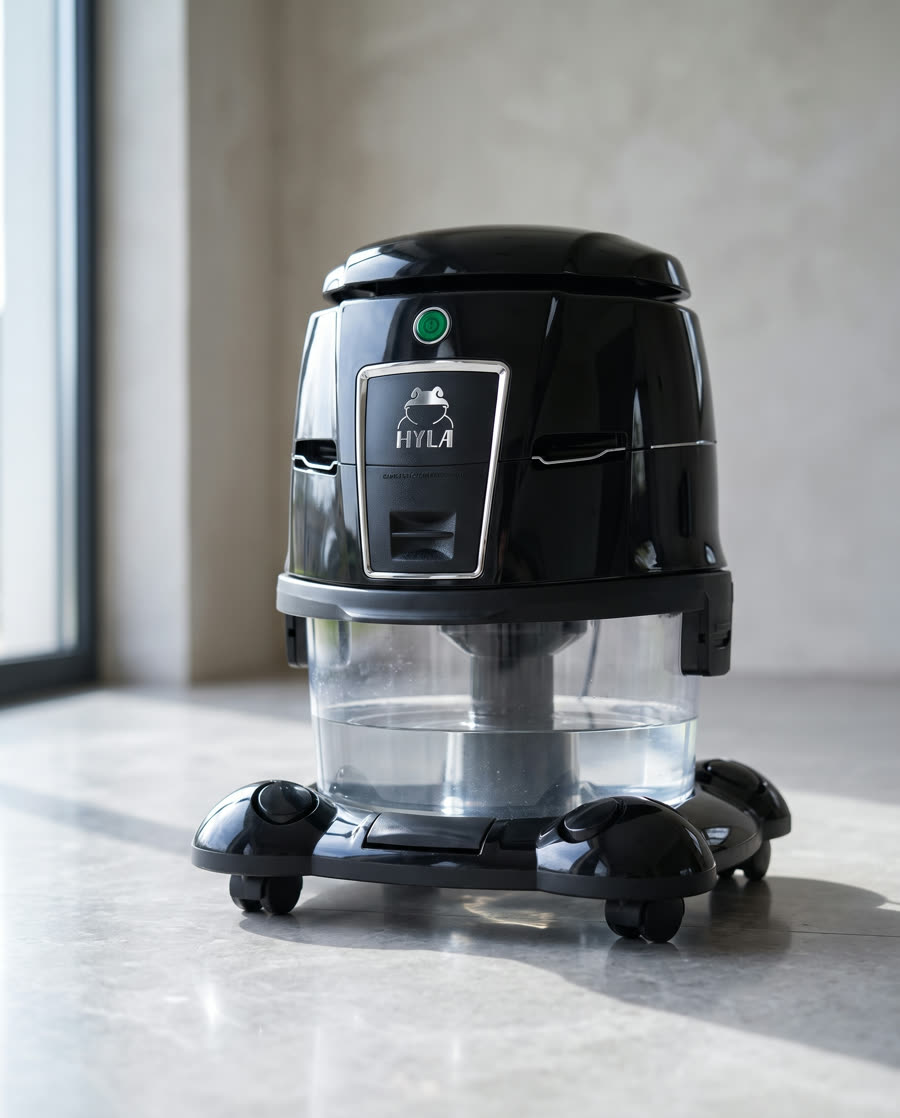
One thing first, because it colours everything below. The Clean Fox is an official HYLA partner. We use HYLA water filter vacuums on our jobs, and we also demonstrate and sell them. We have tried to write this the way we would want to read it from someone else with that interest: what the research says, including where it does not favour water filtration, and what to ask any seller, us included.
How do the three types of vacuum cleaner work?
They differ in how they separate dust from the air before the air leaves the machine. Suction pulls dust in; the collection system decides how much of it stays.
- Bag vacuums pull air through a porous bag. The bag catches the dust, and the air passes through it, often followed by one or more further filters before the exhaust.
- Cyclonic vacuums, often sold as bagless, spin the air so that heavier particles are thrown outwards and drop into a bin. Finer particles stay in the airstream and need filters after the cyclone.
- Water filter vacuums pull the air through a water bath. Dust is wetted and held in the water; a separator spins the air to throw out remaining droplets and particles before it leaves the machine.
HEPA is not a fourth type. It is a class of filter material that any of the three can use as a final filter before the exhaust. “Water filter vs HEPA” is therefore a slightly false contest: the real question is how good each machine is from end to end.
What did the peer reviewed comparison find?
The most direct study we know of compared the three collection methods under laboratory conditions: filter bag, cyclonic and wet collection, published in the journal of the American Industrial Hygiene Association.1 Its findings, in plain terms:
- All three captured particles well at the start. High initial collection efficiency was possible with any of the three methods. None captured the very finest particles tested completely.
- Airflow mattered, and most for water. How much efficiency depended on airflow varied with the design, and the tested wet collectors lost the most when the flow rate dropped.
- All three released dust they had already caught. The tested cyclonic and wet collectors showed high re-release of already collected particles, and filter bags did the same once they were loaded with dust.
- The whole machine decides. The authors concluded that a vacuum’s overall particle emission depends on the primary collector, the other filtration elements and re-release together, not on collection efficiency alone.
Read honestly, the study does not crown a winner. It says that the advertised strength of each type is real at the start, that each one has a weakness in use, and that you cannot judge a vacuum by its separation principle alone. It is one laboratory study, published in 2001, and machines have changed since. But it is peer reviewed, it measured exactly the question buyers ask, and we have not found anything more recent that contradicts it.
What does HEPA actually guarantee?
HEPA guarantees something about the filter material, not about the vacuum. It is a classification for filter media, tested at a defined particle size. A vacuum with a HEPA filter only delivers that performance for the air that actually passes through the filter.
In a vacuum, air under pressure looks for the easiest way out. If the filter seat leaks, if the housing has gaps, or if motor cooling air bypasses the filter, part of the exhaust never meets the HEPA material. That is why some manufacturers distinguish between a HEPA filter and a sealed system, and why the label on the filter tells you less than it seems to.
It is worth noting that the researchers who measured indoor dust in twenty Dubai homes in 2023 collected their samples with a HEPA vacuum.2 HEPA filtration is a serious tool. It is just a property of one part of a machine.
How do the three compare in daily use?
| Bag vacuum | Cyclonic (bagless) | Water filter | |
|---|---|---|---|
| Where the dust ends up | In a closed bag | In an open bin you empty | In water you pour away |
| Weak point found in research | Re-releases dust once the bag is loaded | High re-release of collected dust | High re-release, and the biggest efficiency loss when airflow drops |
| Airflow over time | Falls as the bag fills | Fairly stable, falls as filters clog | Stable, no bag to fill |
| Emptying | Bag out, closed, little contact | Dust cloud risk when emptying the bin | Dirty water poured away, no dust cloud |
| Maintenance | Buy bags, change filters | Wash or change filters | Empty, rinse and dry tank and separator after every use |
| Weight and handling | Light to medium | Light | Heavy when filled, water has to be carried |
| Typical downside at home | Ongoing cost of bags | Messy emptying | Must be cleaned after every use, or the water and tank start to smell |
Two things in that table get left out of most sales talk. A water filter vacuum that is put away with dirty water in it, or with a wet tank, will smell within days; it has to be emptied, rinsed and left to dry every single time. And a cyclone’s open bin means you meet the dust again when you empty it, which is why it is best emptied outside.
Why airflow matters more than any filter in Dubai homes
Because Dubai dust is fine, mineral and plentiful, and a machine that loses airflow loses its grip on exactly that dust. Household dust here is largely ground rock: calcium was the largest element in indoor dust from twenty Dubai homes, at an average of 14,170 mg/kg.2 Outdoors, the monthly mean of coarse particulate (PM10) reaches 178.2 µg/m³ in August, against 54.3 in January, according to our evaluation of three years of Copernicus data.3
That grit settles at the base of carpet pile and in the seams of upholstery. Getting it out takes slow passes with steady, strong airflow. The research finding that wet collectors lose most efficiency when airflow drops turns into practical rules for anyone using a water filter vacuum, including us:
- Run it at full suction on carpets and upholstery.
- Keep the hose and nozzle clear. A partly blocked hose costs more with a water filter than with a bag.
- Use the right amount of water. Too little and the bath does not hold the dust; too much and droplets reach the separator.
- Change the water when it is saturated, not at the end of a whole villa.
Whoever cleans for you, these are things you can watch for on the day.
What should you ask before buying any vacuum?
Ask for evidence about the whole machine, not about its principle. These questions work for any seller, and we are happy to answer them about the HYLA.
- Is there independent test data for the complete machine, including what leaves the exhaust, or only for one filter?
- Is the system sealed, so all exhaust air passes through the final filter?
- What is the final filter, and how often does it need washing or replacing?
- What happens when airflow drops? Ask to see the machine on a lower setting and with the hose partly blocked.
- How is it emptied and cleaned, and how long does that take after each use?
- What does it weigh in use, and can everyone in your home carry and empty it?
- Which surfaces is it approved for by the manufacturer, not by the dealer?
Be careful with percentages that have no source. If a seller quotes a filtration figure, ask which standard it was measured to, by whom, and whether it refers to the filter or the whole machine. A number without those three answers is decoration. We do not quote performance figures for the HYLA, because the manufacturer does not publish any we could cite.
Why don’t demonstrations prove much?
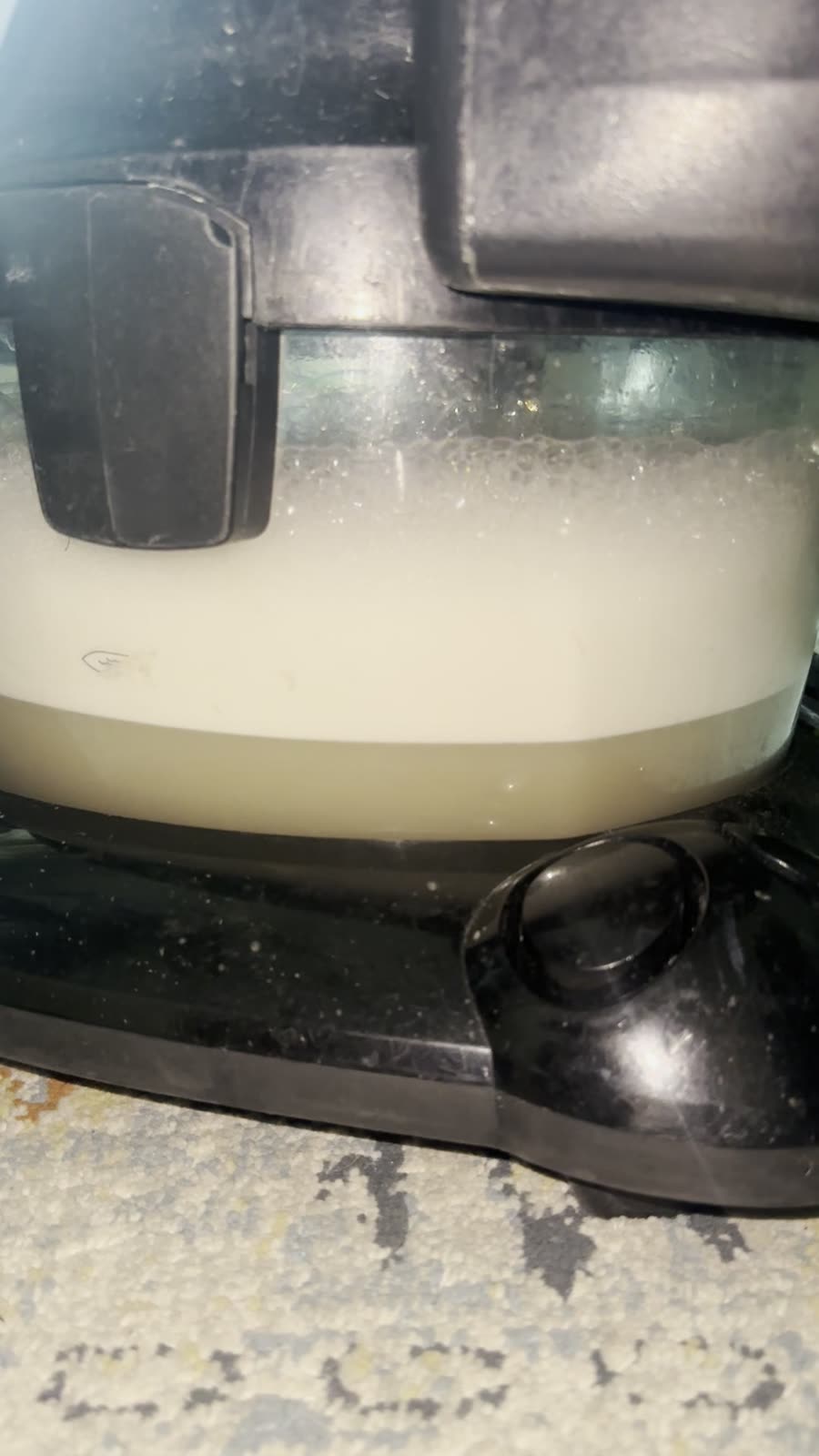
Because a demonstration shows what was collected, never what was missed or released. The classic demo runs a water filter vacuum over a carpet that was just vacuumed with another machine, then shows the murky water. Any vacuum would find more dust on a second pass, because no single pass removes everything, and the water makes the result look dramatic.
We do demonstrations too, and we think they are useful for one thing: seeing how a machine handles, how heavy it is and how emptying works. They cannot tell you about exhaust emissions or long term efficiency. Neither can a glass of cloudy water. For that you need measurements, and the honest summary of the measurements is the one above.
Also be wary of health promises attached to any vacuum. A vacuum removes dust from surfaces. What that means for anyone’s health is not something a seller can measure in your living room, and a promise of that kind is a reason to ask more questions.
Which type makes sense for which home?
| Your situation | What tends to suit it |
|---|---|
| Mostly hard floors, quick daily cleaning | A light bag or cyclonic vacuum; ease of use matters more than the principle |
| Thick carpets and rugs, sandy entrance areas | Strong, steady airflow on a machine that does not lose suction as it fills: a water filter or a well maintained bag vacuum |
| Upholstery and mattresses as well as floors | A machine with good upholstery tools and steady suction at low nozzle speed |
| You want little contact with dust when emptying | Bag or water filter, emptied outside |
| Limited strength or space, or you clean in short bursts | A lighter machine; a water filter vacuum’s weight and after care may not suit |
| You will not clean the machine after every use | Not a water filter vacuum |
Where does a professional clean fit in?
A good vacuum at home and a professional clean do different jobs. Regular vacuuming keeps grit from wearing the pile. A professional clean adds what a home vacuum cannot do: extraction that rinses dirt out of the fibre, steam on heat tolerant surfaces, and time spent on the edges, seams and underside of furniture.
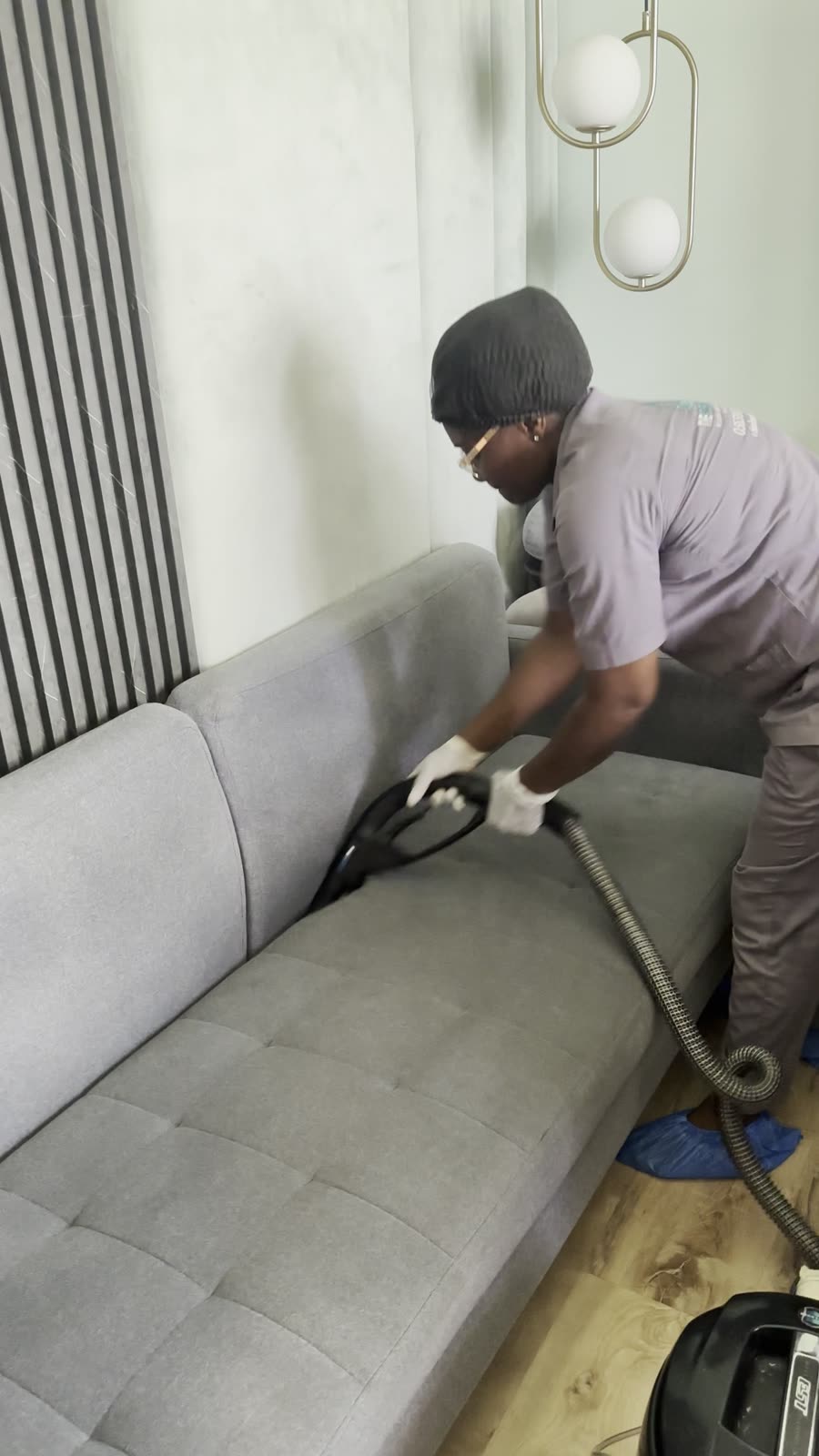
On our carpet cleaning in Dubai, the HYLA does the dry soil removal before anything gets wet, and on sofa cleaning and mattress cleaning it takes out loose dust before extraction or steam. If you want to see one working before you decide anything, ask us for a demonstration, and ask us the seven questions above while we are there. For what vacuuming can and cannot do about dust mites in particular, see our guide to dust mites in UAE homes.