
A musty smell is one of the most frustrating problems in a Dubai apartment, because air freshener hides it for an hour and then it is back. People book an AC clean, then a deep clean, then a carpet clean, and the smell survives all three. The reason is simple: a smell has one source, sometimes two, and money spent on the wrong one changes nothing. This guide is about finding yours first, and being honest about which sources are a cleaning job and which are not.
How do you find where the smell comes from?
Map it with your nose before you change anything. Smell adapts within minutes, so the best moment is right after you come back from outside, ideally after a weekend away.
- Open the front door and stop. Is the smell in the whole apartment or stronger towards one side?
- Walk through each room with the doors closed behind you. Note the room where it is strongest.
- In that room, open cupboards, lift the edge of rugs, sniff near the AC grille, the floor drain and behind furniture on external walls.
- Switch the AC on after it has been off for a while and stand under the grille for the first minute. A burst of musty air at start up points to the unit.
- Note the time of day and the weather. A smell that is worst on humid evenings or after the AC has been off behaves differently from one that is constant.
Write down what you find. If the trail leads to a ceiling or a shared shaft, that note is what you send to the building management.
Which seven sources cause most musty smells?
Seven sources cover almost every case we are asked about. The table gives the tell tale signs, a test you can do yourself, and who normally deals with it.
| Source | Typical signs | Test you can do | Who handles it |
|---|---|---|---|
| Dried out floor trap or basin trap | Sewer or earthy smell in a bathroom nobody uses, stronger after time away | Pour water into every drain, check the next day | You |
| AC condensate tray and drain | Musty burst at start up, drips, gurgling, smell near the indoor unit | Switch on after a pause, smell at the grille; check water at the drain outlet | AC cleaning; a broken tray or line is a repair |
| Wardrobe or MDF cabinet on an external wall | Clothes smell when taken out, spots on the back panel, smell when the door opens | Empty it, smell the back panel and the wall behind | Cleaning and drying; damaged board may need replacing |
| Washing machine | Smell from the drum or detergent drawer, grey marks in the door seal | Pull the drawer out, fold back the seal, look and smell | You, or a home deep clean |
| Kitchen or shower drain | Smell at the plughole, worse after hot water | Flush with hot water, clean the trap and the hair catcher | You; a smell from the building stack is the building’s job |
| Carpet or rug after a spill | Smell when you kneel on it, darker patch, damp underlay | Press a dry paper towel into the spot, lift the corner | Carpet cleaning, if done in time |
| AC coil and blower | Constant smell when the AC runs, dark fluff on the blower blades | Torch behind the filter, look at coil and blower | AC cleaning |
Why does the AC smell worse in winter?
Because water stands longer when the AC works less. In summer the unit runs for hours and the condensate drains steadily. In the cooler months it runs less, the tray holds water for longer and the coil stays damp between cycles. When it starts again, the first air carries whatever has grown in that standing water.
Winter air in Dubai is also damper than people assume. Measured as relative humidity, the outdoor air is actually more humid in January than in July1, even though the dew point is far lower. That is why musty AC smells often surface in December and January, just when nobody expects them.
Dubai Municipality is specific about this part of the system. Its indoor air quality guideline asks for condensate trays to be cleaned at least every month and coils and condensate pipes at least every six months2, and lists “microbiological growth in drip pans, humidifiers, ductwork, coils” among the sources of indoor air contamination2. The US Environmental Protection Agency gives the same advice from another angle: even when booking duct cleaning, ask the provider to “clean cooling coils and drain pans”3.
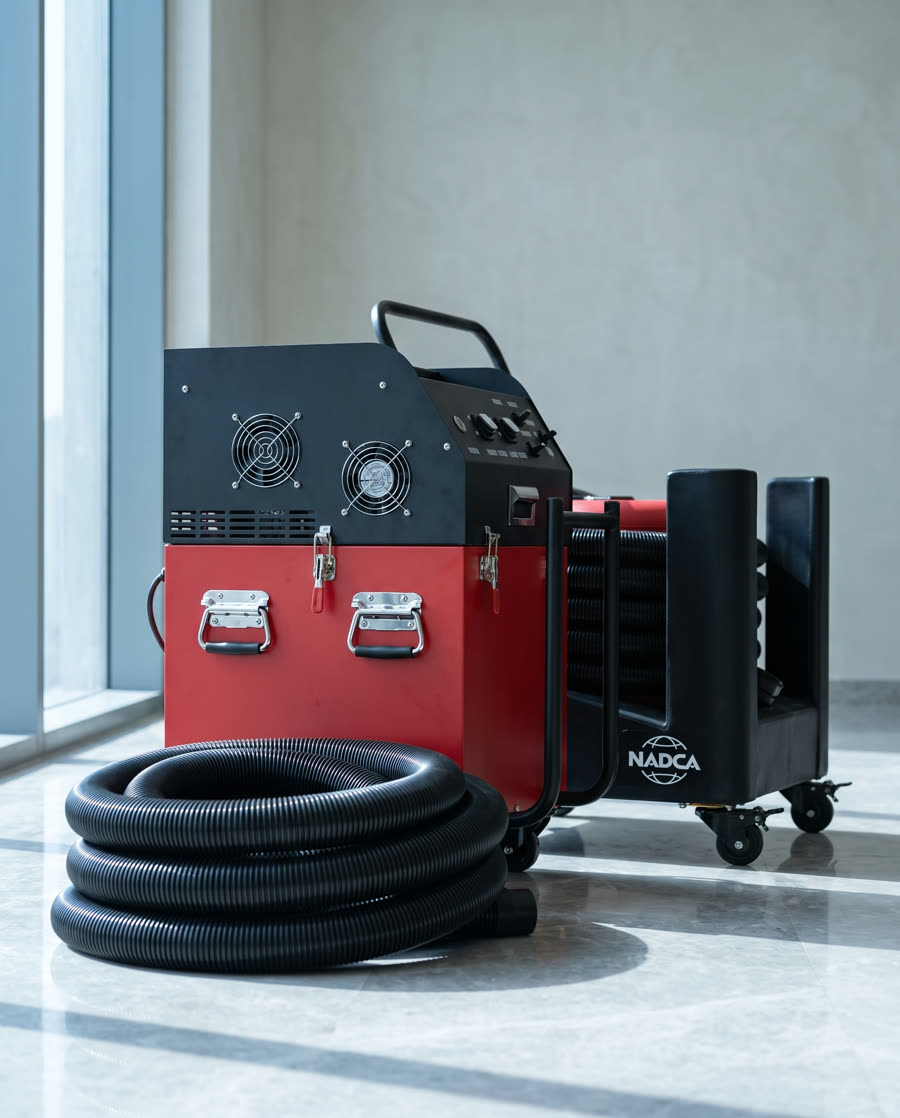
So start with tray, drain and coil. That is the core of our AC cleaning in Dubai, with the drain tested before and after. If the smell persists after that, the ducts or the insulation are the next thing to inspect, and our guide on whether AC duct cleaning is worth it explains when that step makes sense and when it does not.
Why do wardrobes and cabinets on outside walls smell?
Because the back of a wardrobe on an external wall is often the coldest surface in the room, and any surface colder than the dew point of the air around it gets damp. Over the summer months the outdoor dew point in Dubai sits at or above 24 °C in more than half of all hours from July to September1. Where that air reaches a cool wall, through a gap or simply through the building fabric, the back panel absorbs water.
MDF and chipboard soak it up and release it slowly, and the smell gets into the clothes. Empty the wardrobe, clean and dry the inside including the back panel, and leave a finger’s width of space between the cabinet and the wall so air can move. In a home deep clean we open and clean cupboards inside, which is often where the smell turns out to be.
There is a limit, and Dubai Municipality names it: “Discard furniture, carpet, or similar porous material having a persistent musty odor”2. If a board still smells after cleaning and a few dry weeks, the material itself is the problem and no cleaner can change that.
What about the washing machine, drains and carpets?
These three are the quickest to check and often the actual culprit.
The washing machine
Front loaders keep water in the door seal and the detergent drawer. If the door stays shut between washes, both stay wet. Pull the drawer fully out and clean the slot behind it, fold back the seal and wipe out what collects there, and leave the door and drawer open after every wash.
Drains and traps
A trap only works when it is full of water. In a guest bathroom or a utility room floor drain, that water can evaporate in the dry months, and the drainage pipe then breathes straight into the room. Pouring water into each drain is the cheapest test in this guide. If the smell comes from the building’s drainage stack or returns within days, it is a plumbing matter for the building.
Carpets after a spill
Liquid that reaches the backing and underlay of a carpet dries slowly, and the smell starts underneath. Dubai Municipality’s guideline advises to “thoroughly clean and dry liquid spills on porous surfaces such as carpet within 24 hours or discard the material”2. Blot rather than rub, lift the corner to let air under, and if the spot is large, have it extracted early through a professional carpet clean rather than after a week.
Which smells are not a cleaning job?
Some sources need a plumber, a technician or the building, and it is better to know that before you book anyone. These are the ones we regularly see people try to solve with cleaning:
- A leak above the ceiling, from a water heater, a bathroom above you or a chilled water pipe. Signs are stains, bubbling paint or a smell that comes from the ceiling. That is the landlord’s or building’s job.
- Sweating or damaged pipe insulation around a fan coil unit. A building maintenance issue.
- A smell that comes through the shared ventilation shaft or the bathroom exhaust from other apartments. The building has to trace it.
- A sewage smell that returns although every trap is full. A plumbing fault.
- Mould growing back on a wall within weeks of cleaning. Cleaning removes visible growth, but the wall stays wet until the moisture source is fixed.
If any of these apply, document it with dated photos and your notes from the smell map, and send it to the building management or landlord by email. Cleaning comes after the repair, not instead of it.
What should you not do?
Do not cover the smell. Plug in fresheners, scented sprays and candles mask the signal you need to find the source. Do not spray bleach into the AC or onto the coil; it does nothing for a blocked drain and can damage parts. And do not run a dehumidifier in a closed wardrobe as a permanent fix, because it hides a moisture problem rather than solving it.
Do keep indoor humidity under control. Dubai Municipality advises staying below 60 percent2, and a cheap hygrometer tells you whether you are. If the reading is high with the AC running, our guide on why an apartment stays humid with the AC on walks through the causes in order. A musty smell is very often the first visible sign of that underlying problem.